Perge: The Capital of Pamphylia and the Biblical City of the Apostle Paul
Perge is one of Turkey’s largest and most impressive ancient cities, located just 18 kilometers east of Antalya. It was once the capital of the region of Pamphylia and rivaled Ephesus in wealth and grandeur. Today, it is a massive archaeological site covering nearly a square kilometer, where Hellenistic towers, Roman baths, and a magnificent colonnaded street rise up from the grass. Ancient Perge is a must-see for anyone who wants to understand what a typical Roman provincial metropolis looked like.
Unlike the more touristy Ephesus or Side, it’s relatively quiet here even in high season, and you can walk alone on the marble slabs once trodden by the Apostle Paul.
History and Origins
Legend attributes the founding of Perge to the Greek heroes Mopsus and Calchas, who returned from the Trojan War. Archaeologists date the first settlement to the Bronze Age, but the actual city emerged in the 7th–6th centuries BCE. In 334 BCE, before the arrival of Alexander the Great, the inhabitants of Perge voluntarily opened the gates and even provided the army with escorts: the grateful commander did not forget this and spared the city.
After Alexander’s death, Perga became part of the Seleucid Empire, and from 188 BCE—of the Kingdom of Pergamon. In 133 BCE, by the will of Attalus III, the region became a Roman province. It was during the Roman era, in the 2nd century CE, under the emperors Trajan, Hadrian, and the Antonines, Perga reached the height of its prosperity: about 30,000 people lived here, and thermal baths, temples, a stadium, and monumental gates were built. It was in Perga that the famous mathematician Apollonius of Perga, author of the classic work *Conics*, was born.
The Acts of the Apostles mentions that the Apostle Paul and Barnabas landed in nearby Attalia (Antalya) and arrived in Perga during their first missionary journey around 46 CE. In Perga, Paul preached and likely baptized the first local Christians. An important episode also took place here: Paul’s young companion John Mark (the future author of the Gospel of Mark) left the group and returned to Jerusalem, which later became the cause of a conflict between Paul and Barnabas.
In the 4th–5th centuries, the city became a metropolitan see, but after the Arab raids of the 7th century and a devastating earthquake, it began to fall into decline. By the 12th century, Perge had been completely abandoned, and its inhabitants had moved to nearby villages. Archaeological excavations began in 1946 under the direction of Turkish archaeologist Arif Müfid Mansel and continue to this day, revealing new discoveries each season and expanding our understanding of life in the Roman province of Pamphylia.
Architecture and What to See
A tour of Perga takes 1.5–3 hours, depending on your pace. It makes sense to start at the South Gate and head north along the main street.
Hellenistic Gates and Roman Courtyard
The main attraction of the entrance area is two round towers from the Hellenistic period (3rd century BCE), about 13 meters high. They frame a horseshoe-shaped courtyard, rebuilt during the Roman era by the philanthropist Platia Magna—one of the most influential women in Perge. Inside the courtyard stood statues of the imperial family and the city’s founders, many of which now adorn the Antalya Archaeological Museum.
Colonnaded Street
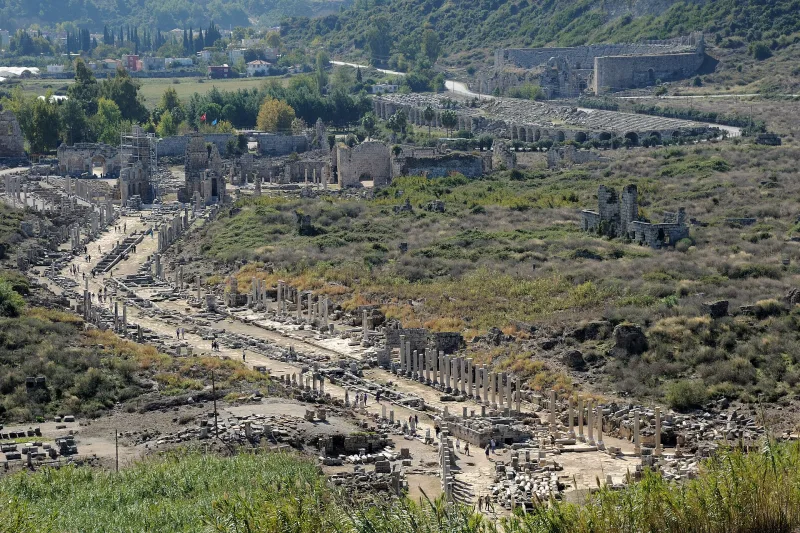
Perge’s main street is nearly 300 meters long and 20 meters wide, with a marble water channel running down the middle. Hundreds of columns once stood on both sides, some of which have been restored. On hot days, the channel supplied cool water from mountain springs to the city center—an elegant solution devised by ancient engineers. To this day, you can still see the tracks of cart wheels on the paving stones.
Thermae and Palestra
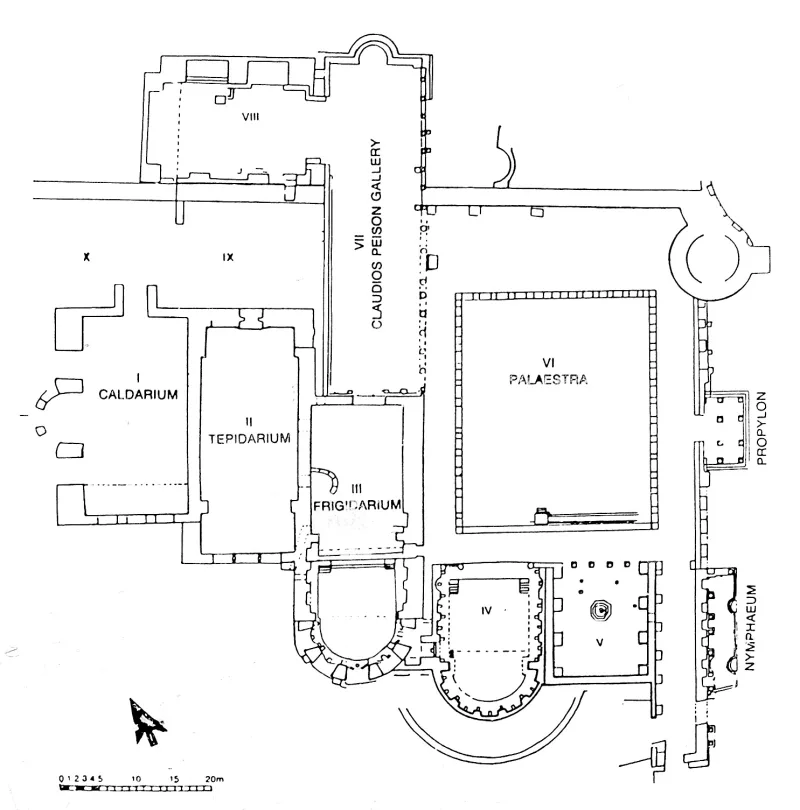
To the left of the main street lies an impressive complex of Roman baths, one of the best-preserved in Turkey. Here you can see the frigidarium, tepidarium, and caldarium, as well as the hypocaust—a floor heating system. Nearby is the palestra, a place for sports, with a distinct rectangular perimeter.
Theater and Stadium
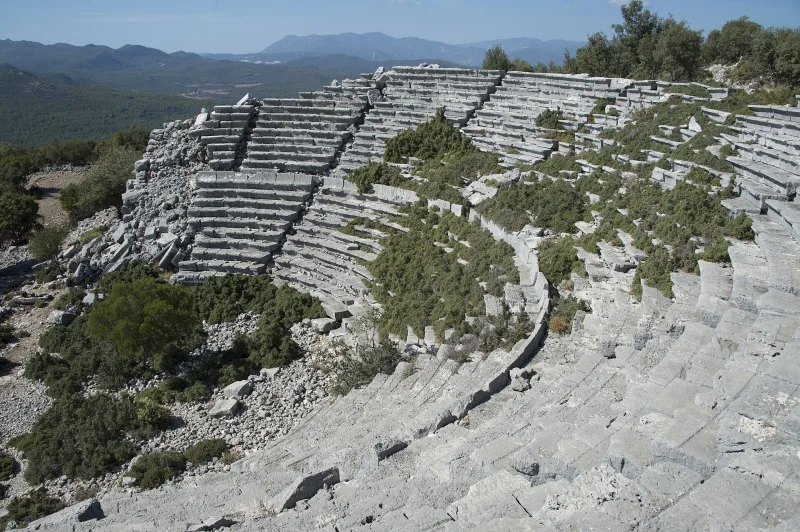
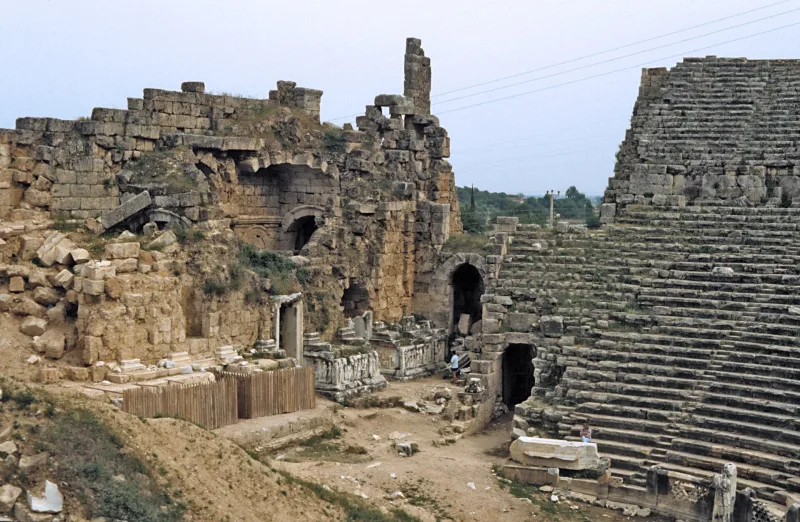
At the southern entrance, beyond the excavation site, stand two massive structures—a Roman theater seating 14,000 spectators and a 234-meter-long stadium that held up to 12,000. The Perge Stadium is one of the best-preserved ancient stadiums in the world: 30 rows of stone benches rest on arched substructures, many of which are still standing. Inside the arches were merchants’ stalls. In ancient times, this was a practical logistical solution—watching a match in the stadium and shopping all in one place. Imagine a crowd of 12,000 fans who, during intermission, head straight to the market stalls where they can buy wine, bread, souvenirs, and even figurines of their favorite gladiators. This is a rare example of an ancient “multifunctional sports and commercial complex.”
The Agora and the Nymphaeum
At the end of the main street lies a square agora with its circular Temple of Tyche at the center. A little further on is the monumental nymphaeum fountain, the source of the city’s water system. From here, you can see the acropolis—the natural hill where the history of Perge began.
Northern Baths and Palestra
A separate complex of northern baths is located at the foot of the acropolis. Here, archaeologists found fragments of marble cladding and sculptures depicting the emperors Antoninus and Hadrian. Nearby is a small palestra, used for the gymnastic exercises of the city’s youth. The marble floor has been partially preserved, but fragments of mosaics with marine motifs are still visible.
Acropolis
The northern part of Perge is a natural hill that served as the first settlement and acropolis. At its summit, you can see the remains of walls, cisterns, and temples. The climb to the acropolis takes about 15–20 minutes, but the views from there of the entire ancient site and the modern surroundings are well worth the effort. It is from the acropolis that it is easiest to understand how the ancient city was laid out—with a regular grid of streets and a system of city gates.
Interesting Facts and Legends
- Platia Magna was a noblewoman of the Roman era who donated vast sums to the development of Perge. Several statues and inscriptions stand in her honor, highlighting the high status of women in Pamphylia.
- In Perge, a specific goddess, Artemis of Perge, was worshipped, whose image differed from the classical one: she was depicted as a stone cone—a remnant of the ancient Anatolian cult of the Great Mother.
- The city was home to one of the finest sculpture schools of the Hellenistic period—many of the statues adorning the Antalya Museum were made right here.
- According to the Acts of the Apostles, the Apostle Paul passed through Perge twice—on his way to Pisidia and back.
- Excavations have been ongoing since 1946 by Turkish archaeologists; new discoveries are made every year.
- Apollonius of Perga, who lived in the 3rd century BCE, wrote an eight-volume treatise on conic sections that influenced all subsequent mathematics—from Copernicus to Newton.
- A rare mosaic floor depicting Orpheus surrounded by animals was found in Perga—today it is on display at the Antalya Archaeological Museum.
How to get there
Perge is located 18 km northeast of the center of Antalya, in the Aksu district. It is one of the most accessible ancient cities for those vacationing on the Turkish Riviera.
By car—take Highway D400 toward Alanya, then turn toward the village of Aksu; signs will lead you to the excavation site. Parking is available at the entrance. The trip takes about 25–35 minutes.
By public transport: from the bus station in central Antalya, take a dolmuş or bus to Aksu; from there, walk about 2 km to the entrance of the ancient city or take a local taxi.
The most convenient option is to include Perge in a day trip itinerary with Aspendos and, possibly, Kursunlu Waterfall—all are located in the same direction from Antalya. Such a trip usually takes 8–10 hours and includes lunch. If you’re on a group tour, you may have less time in Perge than you’d like—usually 1–1.5 hours—and exploring the more distant parts of the city (the acropolis, the northern baths) may not be included in the tour. For a more thoughtful visit, it’s better to choose a private tour or go on your own in a rental car, which is relatively inexpensive in Antalya and significantly expands your itinerary options.
Tips for travelers
Perge is a vast open area with little shade. Bring at least one liter of water per person, sunscreen, a hat, and comfortable shoes. The best time to visit is early morning (8 :30–10 :30) or evening (after 16 :00), when the sun isn’t as intense. Between the columns of the main street, there are areas with small overhangs where you can rest and escape the heat for a few minutes, but such spots are few and far between.
The best time to visit is April–May and September–October. In the height of summer, a visit can be a real challenge; in winter, rain and mud on the marble slabs are possible.
Before visiting Perge, it’s worth stopping by the Antalya Archaeological Museum—it houses nearly all the outstanding sculptures from the site, including a collection of 2nd-century CE statues from the colonnaded street. This will help you “populate” the empty ruins in your imagination.
The Museum Card (Müzekart) is valid here as well, offering significant savings when visiting multiple sites in Pamphylia. The stadium and theater have separate sections and are worth exploring alongside the main site.
Photographers will appreciate the morning light on the colonnaded street: the long shadows cast by the columns create a dramatic rhythm. For a panoramic view of the city, climb to the eastern slope of the acropolis—from there, you can see the entire network of streets. Plan for at least 2 hours, and ancient Perge will reveal itself not as lifeless stones, but as a living Roman metropolis in miniature. Shoot in short bursts to capture the play of light in the marble canal—at the right angle, you’ll get a “mirror ribbon” effect running through the city center. The evening light is also nice, but it’s better suited for wide panoramas than for the details of the carvings.
Be prepared for the fact that the vast excavation site can be deserted. Unlike Side and Aspendos, Perge is less commercially developed, and on weekdays during the off-season, you may find yourself alone with the ruins for half an hour or more. For the contemplative traveler, this is a major plus: you can sit down on one of the stadium’s stone benches, open your guidebook, and imagine the stands roaring with the shouts of 12,000 fans at games held in honor of the emperor.
If you’ve already been to Ephesus and think revisiting ancient cities is uninteresting, Perge will surprise you. The exceptional state of preservation of its stadium and Hellenistic gates is unique, and the landscape—with ancient towers and a marble street in the foreground—differs from that of Ephesus and is memorable in its own way. Try combining your visit to Perge with dinner in nearby Aksu or the coastal town of Lara—after a full day in this Roman metropolis, it’s a pleasure to end the evening with Turkish meze by the sea and reminisce about the marble street under the starry sky of Pamphylia.